

Preparing for 2027:
Key Supply Chain Trends & Planning Considerations
As we head into the final months of 2026, global supply chains are characterized by a mix of stabilizing freight channels and targeted material constraints.
While baseline logistics lead times have normalized, sustained demand in key growth sectors, such as AI infrastructure, aerospace, defense, and power electronics, continues to exert pressure on specific component availability, raw substrate materials, and Advanced Packaging capacity.
Proactive alignment between OEMs and manufacturing partners will be critical to securing material availability, mitigating price volatility, and ensuring production continuity through 2027.
Key Market Conditions & Commodity Trends
Component Availability & Lead Times
Microcontrollers & Power Management (PMICs)
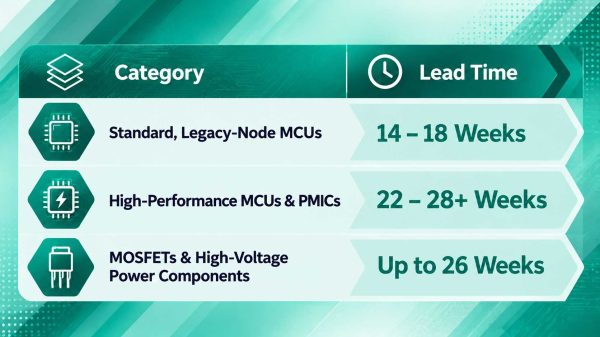
Lead times for standard, legacy-node microcontrollers (MCUs) have stabilized to 14–18 weeks, but high-performance MCUs and specialized Power Management ICs (PMICs) face extended lead times of 22–28+ weeks due to heightened demand from edge-AI infrastructure and automotive electrification. MOSFETs and high-voltage power discrete components show similar pressure, stretching toward 26 weeks. While baseline prices remain stable, power delivery components are experiencing targeted price surcharges driven by rising upstream metal inputs.
Passives & Memory
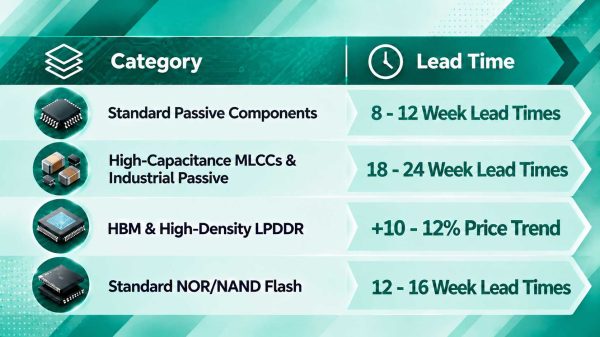
Standard passive components (resistors, standard ceramic capacitors) maintain healthy distribution channel stock, with lead times holding steady at 8–12 weeks. Conversely, high-capacitance MLCCs (0201/0402 case sizes) and high-voltage automotive/industrial passives face localized allocation, extending lead times to 18–24 weeks. Specialized memory modules (HBM, high-density LPDDR) remain heavily constrained with rising price trends (+10–12%), while standard NOR/NAND flash memory maintains moderate 12–16 week lead times.
Pricing
Baseline pricing remains steady, though raw material surcharges (copper, precious metals) are creating upward pressure on select semiconductor lines.
PCB & Material Market Conditions
PCB Base Materials & Substrates
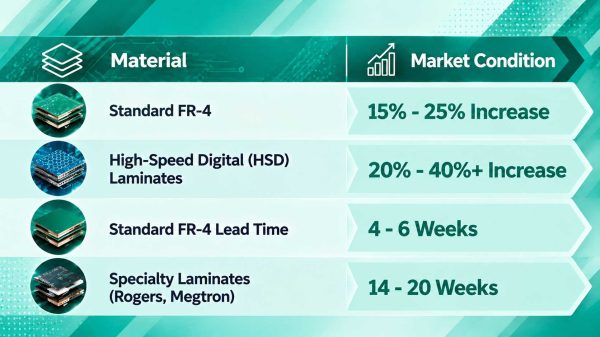
Standard FR-4 base materials are under severe cost and lead-time pressure. Copper-Clad Laminate (CCL) suppliers have instituted cumulative price increases of 15%–25% on standard FR-4 and up to 20%–40%+ on high-speed digital (HSD) laminates due to raw copper volatility and resin feedstocks. Standard FR-4 lead times remain manageable at 4–6 weeks, but specialized high-frequency and ultra-low loss laminates (e.g., Rogers, Megtron) have extended significantly to 14–20 weeks.
Fabrication Capacity
Quick-turn and complex HDI (High-Density Interconnect) board fabrication capacity is heavily committed heading into Q1 2027.
Global Trade, Tariffs & Sourcing
Geographic Diversification
OEMs continue to expand “Nearshoring” and “Friendshoring” initiatives to balance geopolitical risk.
Regulatory & Duty Compliance
Ongoing tariff adjustments and trade compliance checks require heightened visibility into full Sub-Tier supplier locations and origin mapping.

Strategic Planning & Actionable Guidance for 2027
What Can Our Customers Do?
-
Re-Evaluate Safety Stock & DOS Thresholds: Identify critical "Golden Components" or single-sourced parts and adjust Days of Supply (DOS) caps upward to buffer against lead-time spikes.
-
Formalize S&OP Alignment: Maintain tight alignment across Sales, Operations, Procurement, and Engineering to validate demand signals and prevent bullwhip effects.
-
Review Safety Stock Levels: Evaluate safety stock and buffer inventory strategies for strategic "Golden Components" or single-sourced parts heading into the new year.
What Can EMS Partners (We) Do?
-
Run Continuous Risk Audits & MRP Scans: Audit customer BOMs against real-time supply intelligence (e.g., SiliconExpert, Accuris) and ensure ERP/MRP scheduling reflects actual lead-time realities.
-
Leverage Strategic Vendor Relationships: Engage primary distributors and secondary broker networks early to secure factory allocations and mitigate spot market price spikes.
-
Maintain Material-Constrained Scheduling: Ensure Advanced Planning & Scheduling (APS) engines are set to "Consider Material Availability" to prevent floor scheduling ahead of raw material arrivals.
What Can We Expect From Our Suppliers & Fabricators?
-
Provide Early Lead-Time & Allocation Alerts: Issue advance notices on raw material surcharges (CCL, copper) and lead-time drifts before quote validity periods expire.
-
Maintain Dedicated Buffer Stock: Hold strategic inventory reserves of raw substrate materials (copper foil, glass cloth) and high-usage passive reels for contracted demand.
-
Standardize Panel Yields: Collaborate with EMS engineering to optimize panelization and allow flexible substrate substitution without requiring full drawing re-spins.
Planning for the Year Ahead
Navigating the evolving 2027 market requires transparency, early communication, and flexible execution. By sharing long-range forecasts, collaborating on risk mitigation plans, and aligning technical engineering requirements early, Emerald Technologies and our OEM partners can identify potential challenges as soon as possible. We look forward to reviewing your 2027 demand projections and working together to build a resilient supply chain.
Disclaimer: The market data, pricing estimates, component lead times, and supply chain projections referenced in this report represent conditions observed at the time of analysis (Q4 2026). Market intelligence is gathered from direct supplier updates, industry benchmarks, and leading market platforms (including Supplyframe Commodity IQ, Sourceability, and ECIA). Given the dynamic and fluid nature of global supply chains, where material availability, lead times, commodity costs, and supplier allocations fluctuate continuously, this information is provided for strategic planning purposes only and is subject to change without notice. Customers are strongly encouraged to regularly validate current component status and material schedules with their dedicated Program Manager.